 TR
TR  EN
EN  AR
AR  ZH
ZH  FR
FR  DE
DE  IT
IT  PT
PT  RU
RU  ES
ES  UK
UK 
 Can Durağan
 Main Grounding
Main Grounding
In the installation and operation of electrical systems, grounding is primarily done to protect humans and useful animals from dangerous currents. In addition, grounding prevents potential fluctuations and effects on secondary circuits. In our country, the construction and operation of grounding systems are regulated by the Regulation on Grounding in Electrical Installations, which was most recently published in the Official Gazette dated August 21, 2001, and numbered 24500. This regulation explains all the technical details of basic grounding; therefore, when summarizing the points to be considered in the construction of basic grounding, we must understand and carefully apply the following points.
• The foundation ground electrode should be constructed as a closed ring. It should be placed in the foundations of the building's exterior walls or within the foundation platform.
• The foundation ground electrode should be arranged so that it is completely covered with concrete and placed at least 5 cm into the concrete in all directions after the foundation concrete is poured. The end points should be placed outside the foundation.
• The ground electrode should be secured in the concrete with fasteners placed at appropriate distances. For example, it should be secured with 30cm stakes at 2m intervals.
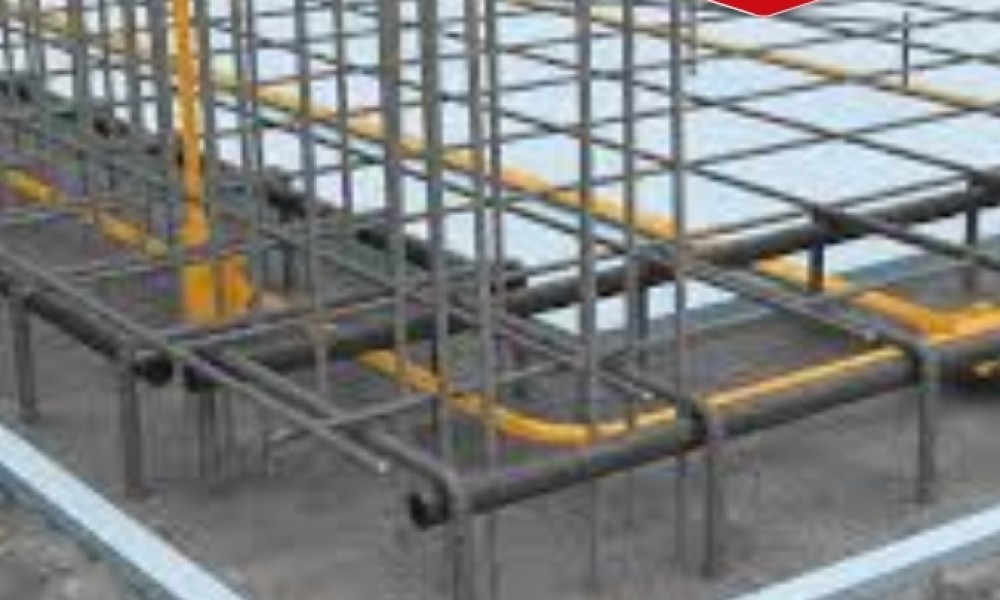
• In reinforced (steel mesh) foundations, the ground electrode should be placed on the lowest layer of steel mesh and connected to the mesh with clamps or square clamps at approximately 2m intervals to secure its position.
• For foundation grounding, hot-dip galvanized steel strips measuring 30 mm x 3.5 mm or round hot-dip galvanized steel monowires with a diameter of 10 mm should be used.
• In buildings with a large footprint, the area enclosed by the foundation ground electrode should be divided into 20m x 20m bays using transverse connections.
• The connection wires of the foundation grounding system must be at least 1.5 m long where they enter the building. These wires must be protected against corrosion at the entry points.
• Where foundation grounding is implemented, a 'potential equalization bar' must be installed.
• To achieve main potential equalization, a connection rod or connection piece should be placed next to the building's main panel by connecting it to the equipotential bonding bar.
• The necessary equipment for disconnecting the grounding conductors during grounding resistance measurement should be located in easily accessible places.
• The mechanical strength of the grounding conductor disconnect switch assembly must be sufficient.
• Materials used in basic grounding should be selected in a way that prevents battery contamination.
• The materials used in the connections of grounding rods must have the same mechanical strength as the rods themselves.
• The foundation grounding also serves as grounding in lightning protection systems. For this purpose, outlets are provided around the building. These outlets can be made of steel strips or cables. The cable cross-section must be at least 50 mm² (NYY).
• When installing the foundation grounding, the details in the foundation grounding project, which is one of the prerequisites for the approval of the building's electrical project, must be strictly adhered to.
